Agent trust model
Why two secrets instead of one
A token alone would prove that someone was allowed to install an agent — it says nothing about whether the agent that actually showed up is the one you meant. If two clusters are enrolling around the same time, or a token leaked, the wrong request could get approved by mistake. That's why enrollment needs two things that never travel together:
- The enrollment token, in the
helm installcommand the UI prints. It proves authorization to attempt enrollment at all. - The approval code, which never appears anywhere the token does. The agent generates it locally on first contact and prints it only to its own pod log — never to the server, never to the UI. The server only ever receives a hash of it (Argon2id, bound to the agent's own public key), so it can check a submitted code without ever having seen the real one.
An administrator has to go read that code from the cluster's own logs and type it into the approve dialog. That step is what turns "someone had a valid token" into "I confirmed this specific agent is the one running where I expect."
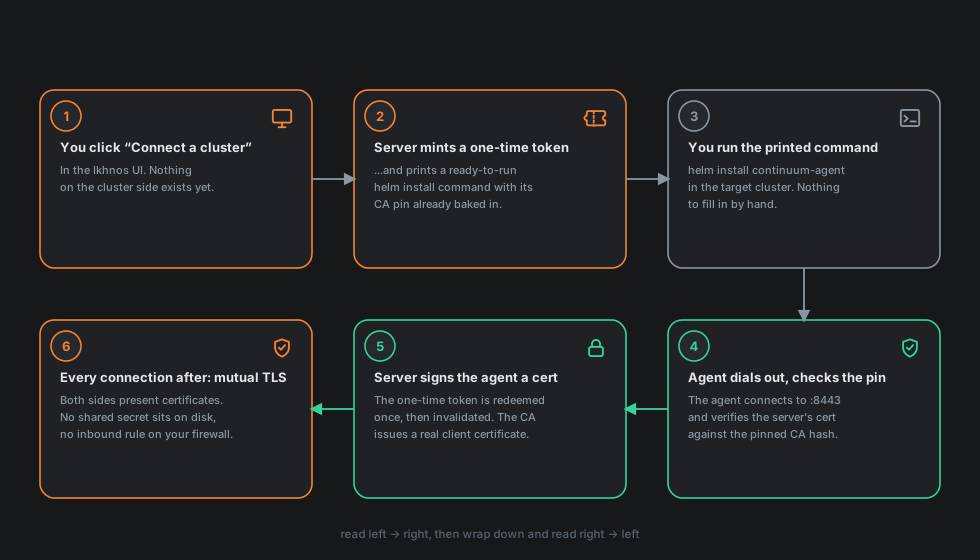
The six steps
- You click Connect a cluster in the UI. Nothing exists on the cluster side yet.
- The server mints a one-time token — valid one hour, one use — and prints a ready-to-run
helm installcommand with its CA pin already embedded. - You run that command against the target cluster. Nothing to fill in by hand: the chart reference, image and CA pin are all already correct.
- The agent starts, dials the server's
:8443, and checks the pin. Before it trusts anything the server sends back, it verifies the server's certificate against the CA pin from the install command — first contact is protected against a wrong pin, wrong host, or a foreign CA entirely. - The server verifies the token and signs the agent a certificate from its own private CA. The token is consumed here — reusing it fails.
- Every connection after this is mutual TLS. Both sides present certificates; there's no shared secret sitting on disk anywhere, and no inbound rule needed on the cluster's firewall, because the agent is the one dialing out, every time, for the life of the connection.
Certificates last 24 hours and renew automatically at the halfway point. An agent that's been offline for less than 7 days re-establishes on its own with no new token needed; longer than that, or if the certificate is explicitly revoked, it needs to enroll again from step 1.
Revocation
Revoking an agent is immediate and checked on every call — a live stream drops at once. It's permanent by design: a revoked agent's pod will keep restarting and trying (Kubernetes doesn't know it's been told "no"), but it exits promptly every time with a clear reason in its log, backing off to a few attempts an hour rather than crash-looping. The fix is always the same: helm upgrade with a fresh token, which clears the revoked marker and enrolls fresh from step 1. Once the tombstone retention has passed, the server also drops the revoked agent's snapshots and its in-memory view.
What a connected agent says about itself
Once the stream is open, the agent's first message is a hello. Besides its version, the Kubernetes version, the ceiling its install sets (the Helm access.tier) and, for a helm command printed in the UI, its namespace and release name, the hello now states two more things:
- A protocol version, a counter that starts at 1. An agent from before the version was stated says nothing, and the server records that as protocol 0 and serves it exactly as it always did.
- Its capabilities, a list of names for things it does:
config-digest(it names the Config it has in force in every heartbeat),diagnostics,release-info,self-stats,link-capabilitiesandchunked-sync. The names and what each one means live in one place in the code,internal/agentcaps, which the agent and the server both use. A capability says what the agent does; what it is allowed to do is still the tier and the consent.
The server keeps both for as long as it runs, in memory, and stores nothing from them. It cuts the list to 32 names of at most 40 characters, drops repeats and anything malformed, and never refuses a stream because of what it says: a version or a name it does not know is recorded as it is, because the agent may be newer. The Config an agent is sent does not depend on them.
From those and from what the server has seen, three conditions are worked out in one place and carried on the agent's document. A condition is True, False or Unknown — and unknown is an answer: it means the server cannot tell, which is not the same as no.
| Condition | What it says | Reasons |
|---|---|---|
Connected | A stream from the agent is open. | Open, NoStream |
ConfigInForce | The Config last sent is the one the agent says it has in force. | Echoed, NotEchoed, AgentDoesNotEcho, NotConnected |
Compatible | The agent speaks a protocol this server serves. | Current, LegacyAgent, ProtocolTooNew, ProtocolTooOld, NotSeenSinceStart |
None of them blocks anything. They are for people and, later, for the decision loop to read. They also do not outlive the server: after a restart they say NotSeenSinceStart until the agent connects again.
One thing does use a capability to decide. When a hello states that the install allows tier 0, that is believed only from an agent that states its ceiling, since a 0 may be a field that was never filled in. An agent that declares diagnostics states it; an agent at protocol 0 is told apart, as before, by whether its hello carried diagnostics. A hello can lower an approval to the ceiling it states and can never raise one.
The upgrade order follows from this: the server first, then the regional operators (which do not send the hello), then the agents. A newer agent against an older server is the one case the protocol does not promise to serve in full, and Compatible says so.
Where this connects
Enrollment and approval decide whether an agent is trusted at all; they say nothing about what it is then allowed to see. That's a separate, ongoing question — see Observability intent for the access tier, paused collectors and excluded namespaces that actually govern a connected agent's scope, all independent of trust.
For the assembled, single-page version of this story — including regional operators, the quick-start gateway token, and what the whole model deliberately does not cover — see Trust model.
For the exact RBAC each access tier grants, verb by verb — see Permissions reference.