System overview
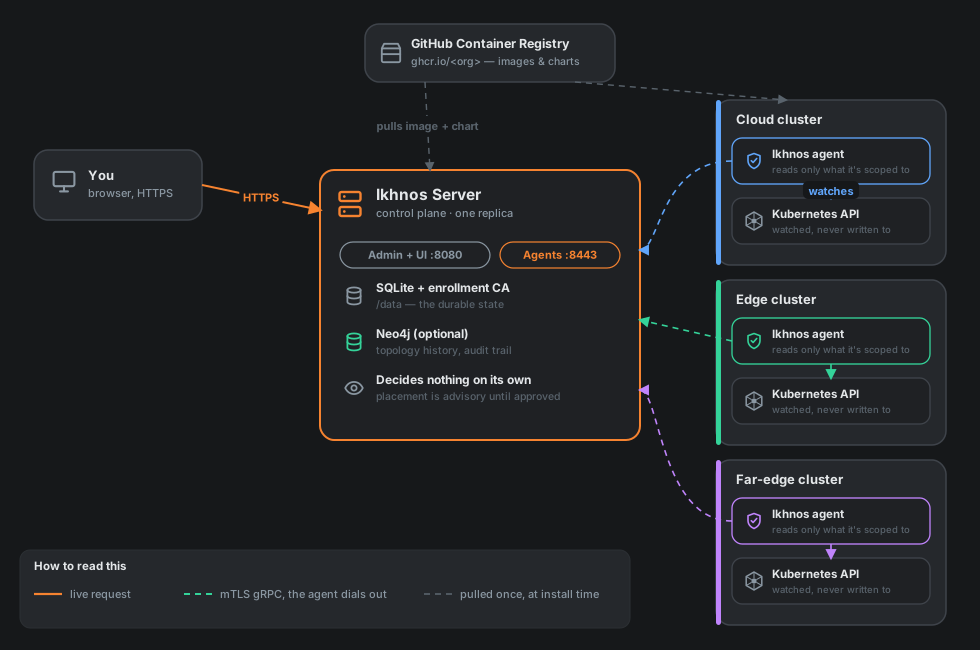
The server
One replica, one PersistentVolumeClaim. It's deliberately not built to scale horizontally: it holds a SQLite database (accounts, sessions, the enrollment CA and its private key) that needs a single writer, plus the in-memory state of every connected agent's live stream. There are two listeners, and they have almost nothing in common:
:8443, the agent port. gRPC over mutual TLS. Agents connect out to this — nothing ever connects in the other direction. The handshake must reach the pod byte-for-byte untouched, which is why this port can never sit behind something that terminates TLS. See Exposing the agent port.:8080, the admin port. The web UI and the JSON API it's built on. Plain HTTP inside the pod, meant to be put behind a Gateway that terminates TLS (or given its own certificate directly withadmin.tls). If you don't provide one, the chart generates a self-signed certificate for it automatically rather than refusing to install — real HTTPS for a trial or LAN-reachable install with nothing else to set up.
Optionally, a Neo4j Community instance (bundled by the chart, or your own external one) holds topology history, change events and the audit trail as a temporal graph — every entity gets versions with a validFrom/validTo, so "what did this look like an hour ago" is one query away, and a Dependents/Dependencies walk can answer what would be affected by a change. Without it, the same things live in SQLite; the server keeps working exactly the same either way, and if Neo4j is briefly unreachable, events simply buffer in SQLite and drain in once it's back. System memory covers this in full.
The server decides nothing on its own. The Placement page's recommendations are advice with evidence attached; nothing is ever deployed or moved without a person approving it.
The agent
One small pod per cluster, with cluster-wide read-only RBAC — it can list/watch, never write, and it never reads Secrets or ConfigMaps at all (that's enforced both by the chart's RBAC and by the agent discarding those fields on arrival if it ever saw them). It authenticates to the server with a short-lived client certificate (mTLS, TLS 1.3), renews itself automatically at half-life, and rejoins on its own if it's been offline for less than 7 days.
Three tiers govern what actually gets reported, always checked in this order: the chart's own access.tier is the ceiling (only a helm upgrade on the cluster's side can raise it), an administrator's approved tier in the UI can only sit at or below that ceiling, and the agent's own effective reporting can only sit at or below what's approved. The server can narrow this at any time; it can never widen past the ceiling, and the agent checks that for itself rather than trusting the server to ask nicely. Tier is only one of three independent narrowings an administrator has, alongside pausing individual collectors and excluding namespaces — see Observability intent for all three, and for how the server enforces them a second time itself.
Clusters and tiers
Every connected cluster is labeled cloud, edge or far-edge — this is what the placement engine's cost function and the topology views group by. There's nothing structurally different about how an agent behaves in each tier; the distinction is about the estate you're modeling, not the software.
Images and charts
The chart's defaults already point at this project's own published images, so none of the install commands on this site — nor the one the server itself prints on the Connect a cluster screen — ever need --set image.repository=....
Where to go next
Agent trust model walks through enrollment step by step — how a cluster goes from nothing to a certificate the server trusts. Observability intent covers what an agent is actually allowed to see and report, and how that scope is narrowed. System memory covers how every change, on any entity, ends up recorded with a reason and a bounded way to ask what depends on what. Exposing the agent port covers the three ways to get real traffic to :8443 and the one mistake (terminating TLS at a proxy) that breaks all of them.