System memory
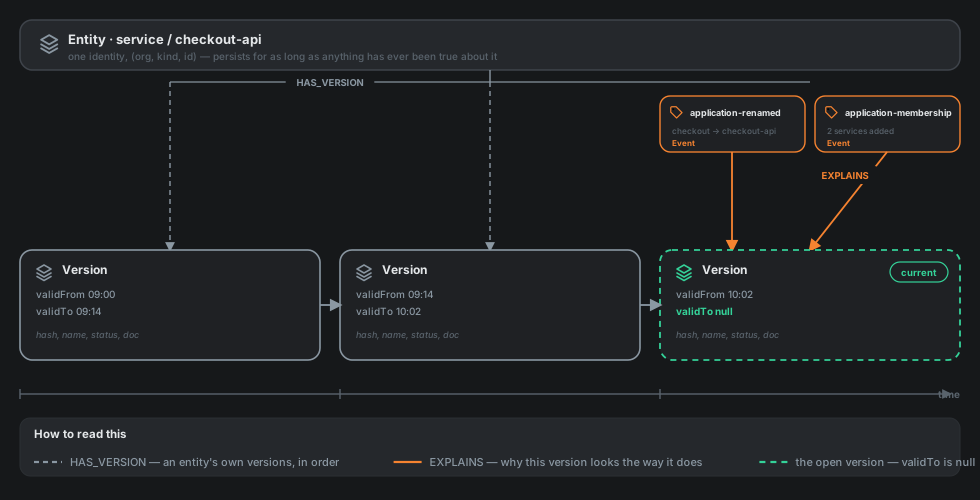
Every entity this server has ever seen — a cluster, a service, a namespace, an agent, an application — is remembered the same way, regardless of which of the nine kinds it is or how it came to be recorded. That uniformity is deliberate: the topology views, the History page's Timeline, and the Dependents/Dependencies graph all work against one shape, not nine special cases.
Entities and versions
An Entity is an identity — (org, kind, id) — that persists for as long as anything has ever been true about it. A Version is one period during which it looked a certain way: a JSON document, a name, a status, a validFrom, and a validTo that is null exactly when that version is the current one; a current version also carries open: true, which the version_open index serves. Recording a new state closes whatever version was open (setting its validTo to the instant of the change) and opens a fresh one — an entity's full history is just its versions in order, and "what did the estate look like as of last Tuesday" is a WHERE validFrom <= t AND (validTo IS NULL OR validTo > t) filter, not a reconstruction from a change log.
Recording is idempotent by design: every version's document is hashed, and handing the same document to the same entity again — the ordinary case, since most of what a poll rediscovers hasn't changed — is a no-op rather than a new, identical version. Two things distinguish this from a naive "diff and skip": a version that closes and reopens at the exact same instant (a snapshot mid-transition) collapses rather than leaving a zero-length version behind, and moving an entity between clusters is tracked as its own fact (the cluster field is part of what has to match for a state to count as "unchanged") even when nothing else about it did.
A service's Entity and Version nodes also carry key, the service's name/namespace/cluster (the member label of the FUSION application info series, which also carries the service's id as service_id), and ns, its namespace, served by the index entity_service_key. A graph at an earlier schema migrates the first time the server starts against it: one index is created and the open service Versions and Entities are filled in. Old and closed Versions stay without key and ns. Reading an entity returns what it did before.
A version holds what is true of an entity, not what it is doing right now, so live readings are left out of its document and a version is created only for a real change; counter noise creates none. Left out are a node's requested resources, pod count, pressure, power, OOM kills, link saturation and counters; pod traffic; and a dependency's retransmits, jitter, handshake and DNS timing, congestion window, pacing, MSS, TCP window and buffer gauges, and DNS query names. Historic topology views therefore do not show them; the live view does. A dependency's RTT and loss are still recorded with each snapshot. This is what makes an unchanged estate cost one snapshot row at tier 2 and above.
Two families of caller produce versions, and both end up in exactly the same place:
Recordtakes a whole topology snapshot — everything a periodic scan found — and diffs it entity by entity against what the graph already holds, closing what has disappeared and opening what changed. This is how clusters, services, namespaces, workloads, dependencies and network paths get recorded: the seven kinds nothing outside a poll ever changes. It never closes an agent's or an application's version, which belong toRecordEntity, so agents and applications appear in history and time-travel like everything else.RecordEntityversions one entity at a time, for state whose owner already knows the exact moment and reason something changed rather than noticing it by comparing two snapshots — an agent's tier, its paused collectors and excluded namespaces, its approval status; an application's declared shape. SameVersion/HAS_VERSIONshape, same idempotence, so Timeline treats an agent's own history no differently from a service's.
Why, not just what
A version alone answers "what changed." Two of this server's nine kinds used to have no way to answer "why" at all — an application's document changing shape in a save, or an agent's tier moving — even though every other kind (a service scaling, a namespace's labels changing) already came with a plain-language reason via the same polled-topology diff that produces service-added, service-scaled, and so on.
The fix is the same mechanism extended to cover them: an Event — a timestamped, kind-named, human-readable record (agent-tier-changed, application-renamed, application-membership, application-removed, …) — written at the same instant as the version it explains, then linked to it with an EXPLAINS edge. LinkEventChanges does the linking: it matches an event to whichever version of the same target opened in the same one-second window, so a caller only has to write the event and call it — it does not have to already know which version its own change produced. Timeline shows both sides of this: Explains on a version is why this one looks the way it does, and the plain Events list on an entity is everything ever noticed about it, including removals that have no surviving version left to attach to.
One save can explain itself more than once. Renaming an application and clearing its membership in the same save produces two events — application-renamed and application-membership — both linked to the one version that save produced, rather than a single flattened "something changed" event losing the distinction. The same discipline the polled diff already followed (one event per changed fact, not one per changed entity) now applies uniformly.
The relationships between entities
Six relationship types connect entities to each other — IN_CLUSTER, RUNS_ON, CALLS, PATH_FROM, PATH_TO, CONTAINS — and every one of them is temporal the same way a version is: closed (validTo set) when it stops being true, never deleted. While current, each carries open: true, indexed per type (rel_<type>_live); rel_<type>_open, on (org, validTo), remains. The graph schema is at version 4. A service that moves clusters does not lose its history of having been in the old one; a dependency that stops being called is closed, not erased. Application membership. An application's CONTAINS edges to its services are fed from the workspace's applications, which include members that come from accepted discovery hints. They are written when the recorder saves a snapshot, not only when the workspace is saved, so membership follows a hint or a workspace edit at the next recorded snapshot. Linking is idempotent: the edge is merged, and opened only if it is not already open. An edge for a member dropped from an application is closed, and so are all the edges of an application that is soft-deleted, which also gets an application-removed event and is gone from the open graph.
This is also why a relationship's own validity has to be checked separately from its endpoints' — an edge from a year-old, now-closed version of one entity to a current version of another is exactly the kind of thing "as of last Tuesday" has to get right, and getting it wrong silently is worse than a missing edge.
What depends on what
Given one entity and a moment, Dependents answers "what would be affected if this changed" and Dependencies answers "what does this itself rely on" — the same walk over those six relationship types, in opposite directions, out to a caller-supplied number of hops (/graph/dependents and /graph/dependencies, both ?kind=&id=&at=&hops=).
The walk moves level by level — breadth-first, one query per hop, over only the entities the previous level reached and had not already visited — rather than asking the database to enumerate every path through a *1..hops variable-length pattern in one query. That distinction matters specifically because relationships are never deleted: a node with a long history behind it, or genuine fan-out (a handful of shared services with hundreds of callers each), can carry far more edges than it has distinct neighbors, and a variable-length pattern walks every one of those edges as a separate path before it can collapse them back down to "reached, at its shortest distance." The cost of that is exponential in the branching a query happens to meet; a level-by-level walk with a visited set costs work proportional to the frontier's actual size instead, at the price of up to eight round trips to the database instead of one — cheap next to a query that might never return.
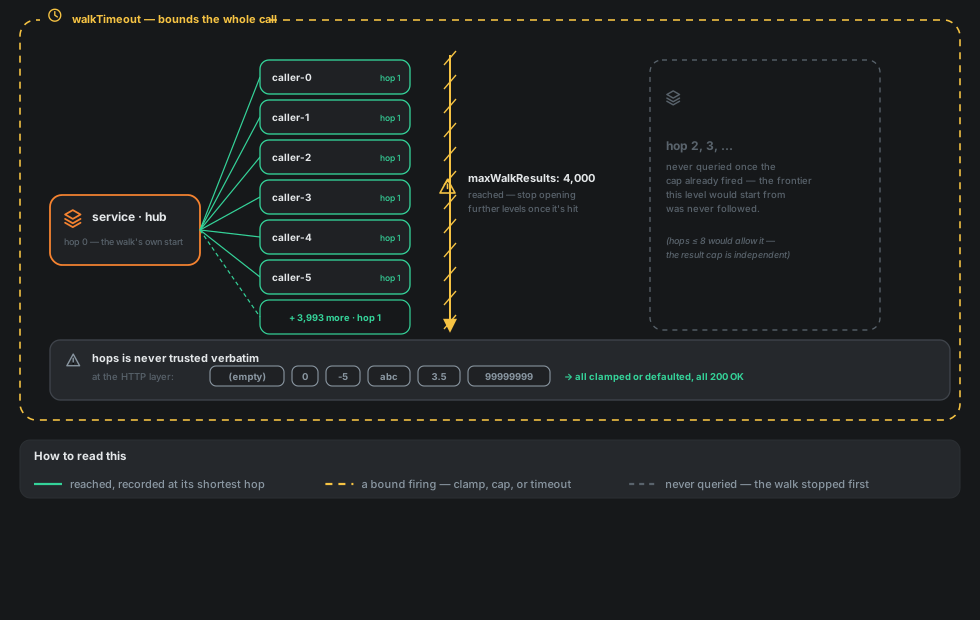
Three independent limits keep any single call bounded regardless of what the estate looks like:
- Hops are clamped to 8 regardless of what a caller asks for — including nonsense input (empty, negative, non-numeric, absurdly large) at the HTTP layer, which falls back to the documented default rather than erroring.
- Results stop growing past 4,000 entities: a walk that keeps finding more at every level stops opening further hops and returns what it already has, because answering "what's connected" was never meant to enumerate an entire estate.
- Wall-clock time is capped across the whole call, not just each individual round trip to the database — a walk this deep makes up to ten round trips in total (the hop levels, plus the existence check and the final batch fetch), and being merely unlucky on every one of them could otherwise take a single request's own timeout multiplied by that count. Once the overall budget fires, the in-flight call fails immediately with a clear deadline error rather than quietly running past what a caller would consider reasonable.
None of the three changes what a walk finds within them — only what happens once an answer would otherwise have gotten implausibly large or slow, which is precisely the situation a real, long-lived, historical graph eventually reaches and a small demo one never does.
Without Neo4j
Everything above needs the temporal graph specifically — it is the one place validFrom/validTo windows, EXPLAINS edges and multi-hop walks exist. The server does not require it: Neo4j is optional (bundled by the chart, or an external instance you already run), and without it, topology snapshots, events and the audit trail still live in SQLite exactly as they always have — the server works the same either way, just without Timeline's "why" or a Dependents/Dependencies answer. If Neo4j is briefly unreachable, nothing is lost: events buffer in SQLite and drain into the graph once it is back, and every graph write in this server is written to be best-effort and silent on its own failure, on purpose — the durable record of that something changed is never the graph's to guarantee, only the richer why and what's connected views built on top of it. A failed write of an event or a snapshot is retried on the next scan.
Where this ends up
Observability intent is the other half of this: every tier change, pause and exclusion an administrator makes is itself recorded through RecordEntity, with an event and an EXPLAINS edge, the same as anything else on this page. An agent's own Timeline entry looks exactly like a service's for that reason — not because agents and services are alike, but because "record what changed, and say why" was built once and used everywhere.